Compound Interest Calculator
Grow savings with compounding: principal, rate, years, frequency → future value, table + chart.
How to use
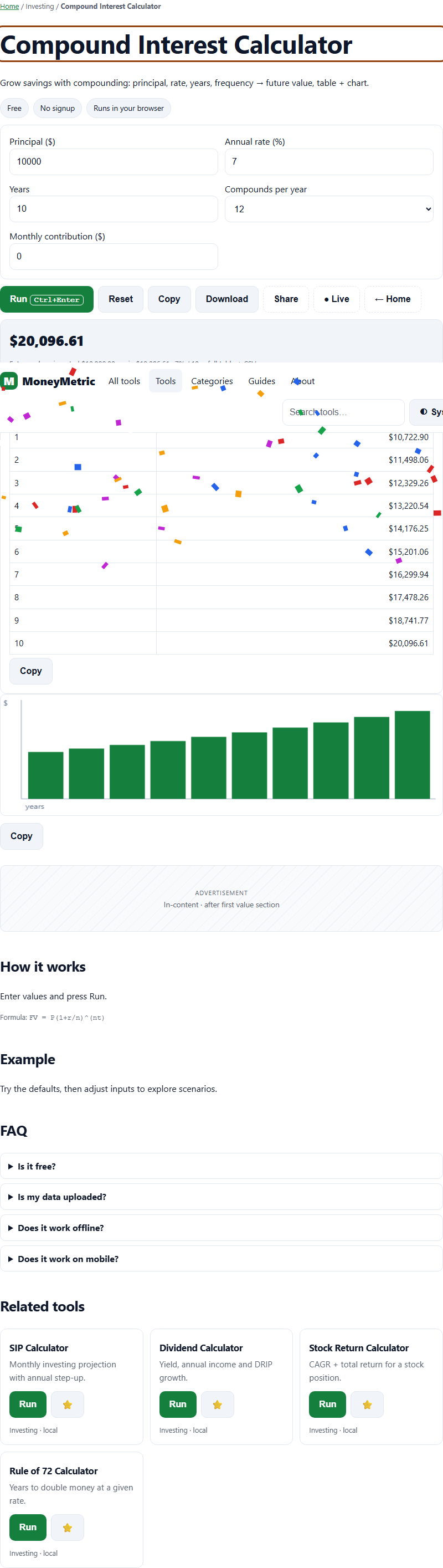
This calculator uses the compound interest formula FV = P(1 + r/n)^(nt), where P is the initial principal, r is the annual interest rate, n is how many times interest compounds per year, and t is the number of years. Compounding frequency matters more than most people expect: $10,000 at 7% grows to about $19,672 after 10 years with monthly compounding versus $19,672 with annual — but over 30 years the gap widens from a few hundred dollars to over $2,000. The calculator also supports regular monthly contributions, which compound alongside your initial deposit. Use it to compare conservative savings rates against index-fund returns, or to see how starting 5 years earlier changes the final balance.
Steps
- Enter the initial deposit in "Principal ($)" — for example 10000.
- Set the "Annual rate (%)" using your expected return, for example 7.
- Choose "Compounds per year": 12 for monthly, 365 for daily.
- Set "Years" and add a "Monthly contribution ($)" if you plan to save regularly.
FAQ
What is compound interest?
Interest calculated on both the initial principal and the accumulated interest from previous periods. It makes your money grow exponentially rather than linearly — the longer you leave it, the faster it grows.
How often should interest compound?
More frequently is better for savers, worse for borrowers. Daily compounding (n=365) earns slightly more than annual, but the difference is modest unless rates or terms are large.
Is 7% a realistic return?
It is a common assumption for diversified index-fund returns over long periods, but past performance does not guarantee future results. Use your own expected rate.
Does this calculator account for inflation?
No — it shows nominal future value. To see purchasing power, use the Inflation Calculator or subtract your expected inflation rate from the annual rate.
Is Compound Interest Calculator really free?
Yes. No account or credits are required, and no paywall blocks the task. Browser, device, and stated file-size limits still apply. Ads may appear only when configured and enabled after the required consent signal.
How should I compare Compound Interest Calculator with other options?
Compare supported inputs, output quality, file-size limits, browser compatibility, and privacy terms using the same sample. Provider features and terms can change; check their current documentation.
How accurate is Compound Interest Calculator?
Results are educational, not professional financial advice — confirm big decisions with a qualified advisor.
Content continues below
Compare before choosing
Compare supported inputs, output quality, limits, browser compatibility, and privacy terms before choosing a tool for calculators for loans, mortgages and investing. Feature checklist.